💡 Why This Matters
Most of us think of sunburn as a passing irritation. However, repeated sun damage can build silently over years, eventually leading to skin cancer, the most common type of cancer worldwide.
The good news is that most skin cancers are preventable. And even when they do occur, they are often treatable — especially if detected early. Therefore, learning how to spot skin cancer early and protect your skin is a simple but powerful step for your long-term health.
🧬 What Exactly Is Skin Cancer and Why Does It Develop?
Skin cancer happens when skin cells grow uncontrollably, usually due to damage from ultraviolet (UV) radiation from the sun or tanning beds.
There are three main types:
- Basal Cell Carcinoma (BCC): The most common, often appearing as a shiny bump or pink patch. It grows slowly but can cause damage if ignored.
- Squamous Cell Carcinoma (SCC): More serious, typically presenting as a scaly patch, sore that doesn’t heal, or wart-like growth.
- Melanoma: Less common but far more dangerous, as it spreads quickly.
Because melanoma can be life-threatening, recognising early warning signs is vital.
🔍 How Can You Recognise the Early Warning Signs?
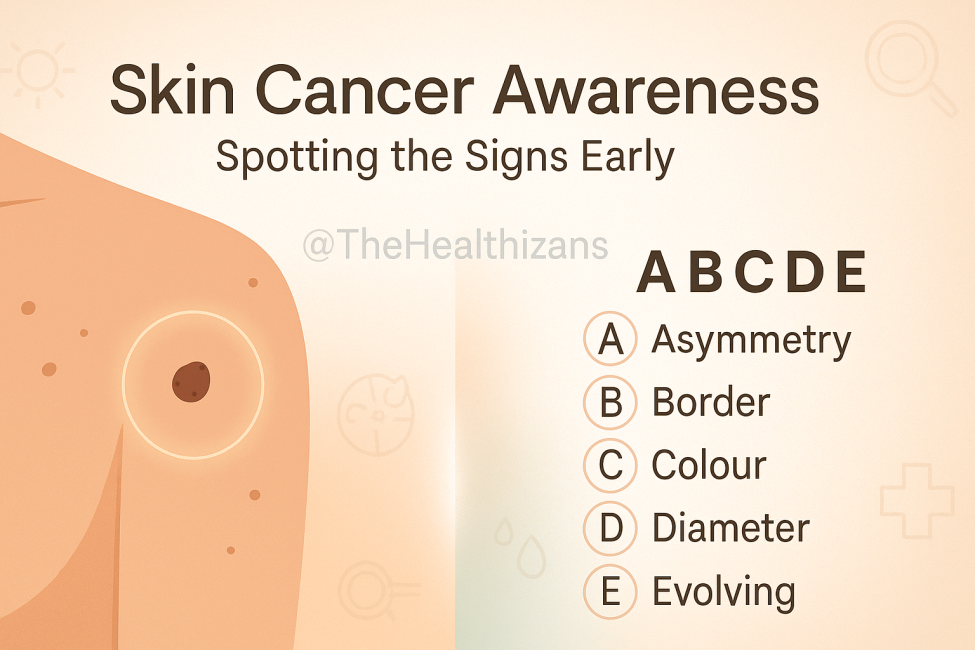
Dermatologists recommend the ABCDE rule when checking moles or skin spots:
- A – Asymmetry: One half of the mole doesn’t match the other.
- B – Border: Uneven, ragged, or blurred edges.
- C – Colour: Multiple colours or unusual shades (red, white, blue).
- D – Diameter: Larger than 6 mm — about the size of a pencil eraser.
- E – Evolving: Any change in size, shape, colour, or behaviour such as bleeding or itching.
👉 If a mole or spot meets any of these criteria, book a check-up with your GP or dermatologist promptly.
🌞 Who Is Most at Risk of Skin Cancer?
Although anyone can develop skin cancer, certain factors increase risk:
- Spending long hours outdoors without sun protection.
- Having fair skin, light eyes, or blond/red hair.
- Experiencing multiple sunburns, especially in childhood.
- Using tanning beds.
- Having a personal or family history of skin cancer.
Importantly, even those with darker skin tones are not immune. As a result, everyone benefits from sun protection habits.
🛡️ What Can You Do to Lower Your Risk?
- Use Sunscreen Daily: Apply SPF 30 or higher, even on cloudy days, and reapply every two to three hours if outdoors.
- Seek Shade: Stay out of direct sunlight between 11 a.m. and 3 p.m., when UV rays are strongest.
- Cover Up: Wide-brimmed hats, sunglasses, and long sleeves add an extra layer of defence.
- Skip Tanning Beds: They expose you to harmful artificial UV radiation.
- Check Your Skin Monthly: A mirror or a partner can help you check hard-to-see areas.
For tips on protecting your skin day to day, see our article on Daily Habits That Keep Your Skin Healthy All Year Round.
⚠️ When Should You See a Doctor?
See your GP or dermatologist if you notice:
- A mole that changes in appearance.
- A sore that fails to heal within a few weeks.
- New lumps, bumps, or discoloured patches on your skin.
Early detection is crucial — it significantly improves treatment outcomes.
✅ Key Takeaways
- Skin cancer is common but preventable.
- The ABCDE rule helps you detect suspicious moles or spots early.
- Sunscreen, protective clothing, and regular self-checks are your strongest shields.
- Anyone — regardless of skin type — can be at risk.
🤝 What’s Your Take?
Do you check your skin regularly for new or changing moles? Would you like us to create a step-by-step self-check guide on how to spot skin cancer early you can follow each month? Share your thoughts in the comments.
📚 Sources
- NHS: Skin Cancer (Melanoma and Non-Melanoma)
- World Health Organization: Skin Cancer Prevention
- American Cancer Society: Signs and Symptoms of Skin Cancer
About the Author