When someone suddenly collapses and stops breathing, every second counts. Yet many people hesitate because they’re unsure what to do. Learning how to recognise and respond to a cardiac arrest can make the difference between life and death. ❤️
⚡ What Exactly Is a Cardiac Arrest?
A cardiac arrest occurs when the heart’s electrical system malfunctions and the heart stops pumping blood. Without quick action, the brain and organs are starved of oxygen.
It’s not the same as a heart attack — which happens when blood flow to the heart is blocked but the heart is still beating. (See our earlier article Cardiac Arrest vs Heart Attack: What’s the Difference?)
👀 How to Recognise a Cardiac Arrest
Someone having a cardiac arrest will usually show three clear signs:
- Sudden collapse – The person may fall to the ground without warning and won’t respond when you shake or shout their name.
🧠 This happens because blood flow to the brain stops instantly. - No normal breathing – They may not breathe at all or may gasp irregularly (called “agonal breathing”).
🫁 Agonal gasps are not real breaths — they mean the brain is still struggling for oxygen. - No pulse or movement – The person’s body may go limp, and their lips or fingertips may turn pale or blue.
💔 These are signs that the heart has stopped circulating blood.
If you see all three signs, act immediately — don’t wait for a medical professional to confirm.
📞 Step 1: Call for Help
- Dial 999 right away.
- Put your phone on speaker mode so you can follow the operator’s CPR instructions.
- If others are nearby, ask one person to start CPR while another finds a defibrillator (AED).
🚑 Early action is the first link in the “Chain of Survival.”
💪 Step 2: Start Chest Compressions (CPR)
If the person isn’t breathing normally:
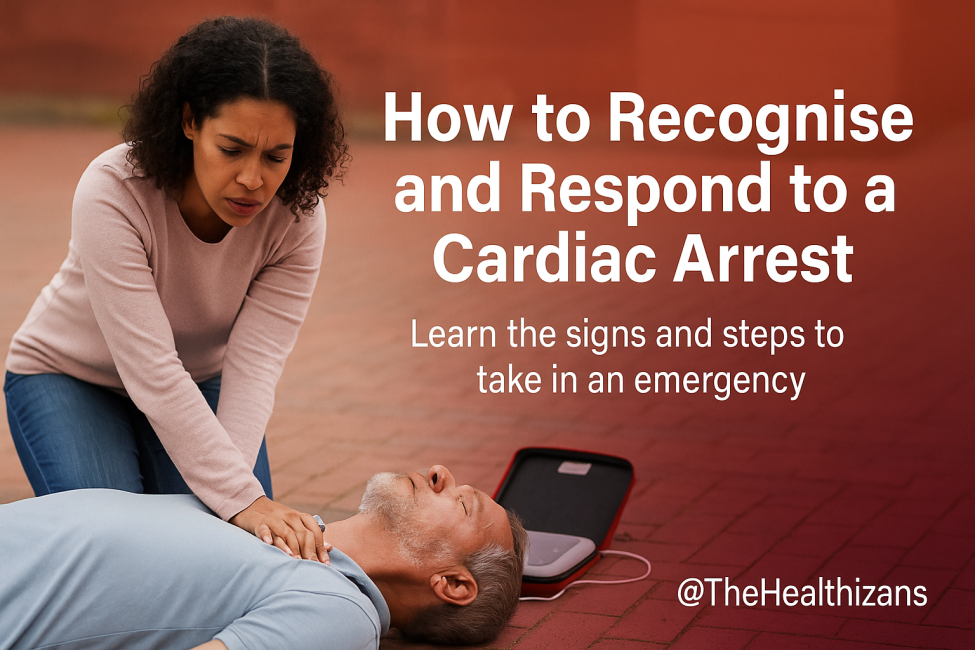
- Place the heel of your hand in the centre of their chest.
- Put your other hand on top and lock your elbows straight.
- Push down hard and fast — 5 to 6 cm deep, at a rate of 100–120 compressions per minute (to the beat of Stayin’ Alive 🎵).
- Let the chest rise fully between compressions.
💬 If you’re not trained, do “hands-only CPR” — no need for mouth-to-mouth.
Each compression acts like a manual pump, helping oxygen circulate to the brain and heart until help arrives.
⚡ Step 3: Use an AED (Defibrillator)
If someone brings a defibrillator:
- Switch it on and follow the voice prompts — it will guide you step by step.
- Expose the chest, wipe it dry, and attach the pads as shown in the diagram.
- Make sure no one is touching the person when the shock is delivered.
The AED checks the heart rhythm and delivers a shock only if needed. Don’t be afraid — you can’t harm the person by using it.
📍 Many public places — airports, schools, gyms, supermarkets — now have AEDs accessible to everyone.
🫀 Step 4: Continue CPR Until Help Arrives
- Keep going with compressions and follow AED prompts.
- Don’t stop unless the person starts breathing normally, a medic tells you to, or you become too exhausted to continue.
Remember: Every minute without CPR reduces survival chances by about 10%.
🌿 After the Emergency
Once the person’s heartbeat returns and help has arrived:
- Place them in the recovery position if they’re breathing normally.
- Stay nearby to reassure them.
- Give emergency services any details you observed — such as how long they were unresponsive or whether a shock was given.
After such an event, it’s normal for rescuers to feel shaken. Taking time to talk about the experience — even with a professional — can help you process it.
💡 Final Takeaway
You don’t need to be a doctor to save a life.
Just remember the simple chain:
Call → Push → Shock → Stay.
When cardiac arrest happens, you are the first responder. Quick, confident action gives someone their best chance of survival.
💬 What’s Your Take?
Have you ever seen a defibrillator in your community or workplace? Do you know where the nearest one is located? Let’s talk about it below
📚 Sources
- Resuscitation Council UK. How to recognise and treat a cardiac arrest.
- British Heart Foundation (BHF). Hands-only CPR guidance.
- NHS UK. Emergency first aid and CPR advice.
About the Author