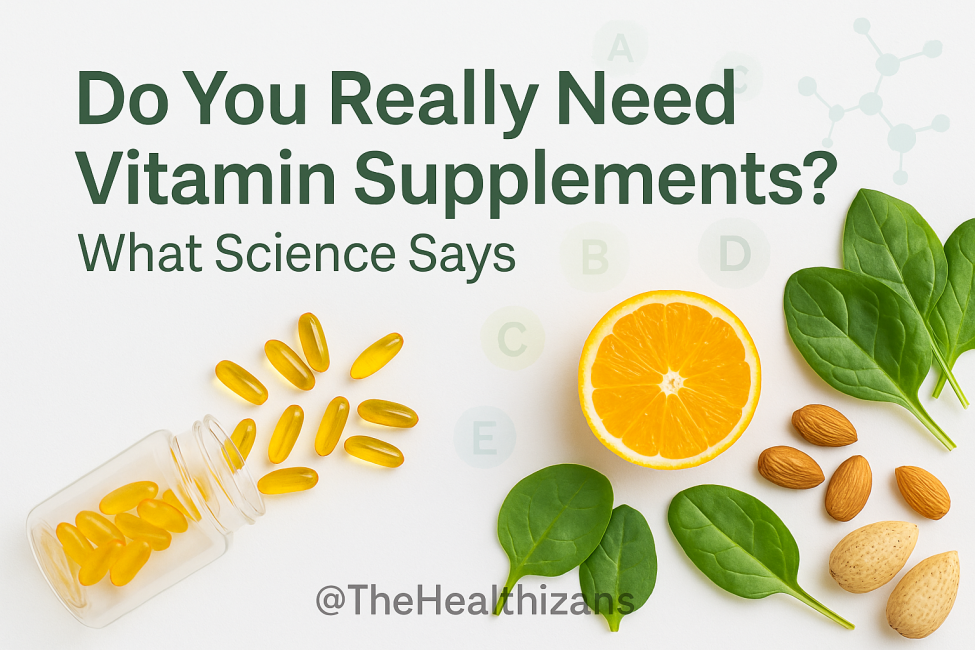
Walk into any supermarket or pharmacy and you’ll find rows of colourful vitamin bottles promising stronger immunity, glowing skin, or better energy. But with so many options, one question keeps popping up — do we really need vitamin supplements?
The answer isn’t a simple yes or no. Science shows that while vitamin supplements can be helpful for some people, they’re not a magic fix — and often, a balanced diet provides everything most of us need. Let’s break down what the evidence actually says about when supplements help, when they don’t, and how to use them wisely.
🍎 1. Why People Take Vitamin Supplements
From boosting immunity to fighting fatigue, many people turn to vitamin supplements hoping for a quick health upgrade. Common reasons include:
- To fill dietary gaps in busy lifestyles
- To strengthen the immune system
- To support bone, skin, or eye health
- During pregnancy or recovery
And while supplements can play a role, experts agree they should complement — not replace — healthy eating.
🧬 2. What the Science Really Says
According to research from the Harvard School of Public Health and the World Health Organization, most people who eat a balanced diet rich in fruits, vegetables, and whole foods don’t need daily supplements.
In fact, some large studies have found little or no benefit from routine multivitamin use in healthy adults. For example, a 2013 study in Annals of Internal Medicine concluded that multivitamins did not reduce the risk of heart disease or cancer in the general population.
However — and this is key — supplements can be crucial for people with specific deficiencies or conditions.
🩺 3. When Vitamin Supplements Are Truly Needed
There are times when vitamin supplements make a real difference:
- Pregnancy: Folic acid and vitamin D are vital for baby development.
- Limited Sun Exposure: Vitamin D supplements are recommended by the NHS during autumn and winter months.
- Vegan or Vegetarian Diets: Vitamin B12 supplements are often necessary.
- Older Adults: May benefit from calcium and vitamin D to protect bone health.
- Certain Medical Conditions: Some illnesses or medications interfere with nutrient absorption.
🩻 Tip: Always check with your GP before starting supplements — more isn’t always better.
⚖️ 4. The Risks of Over-Supplementation
Here’s what many don’t realise: taking too many vitamin supplements can actually be harmful.
Fat-soluble vitamins like A, D, E, and K are stored in your body — and excess amounts can build up to toxic levels.
- Too much vitamin A can harm the liver.
- Too much vitamin D can cause calcium overload.
- Mega-dosing on supplements doesn’t make you healthier — it just makes expensive urine! 😅
The NHS advises getting nutrients mainly from food, unless your doctor recommends otherwise.
🥗 5. Real Food First: The Smarter Approach
Whole foods provide more than just isolated vitamins — they come with fibre, antioxidants, and plant compounds that work together for better absorption.
For example:
- Vitamin C from oranges supports immunity and helps absorb iron.
- Leafy greens deliver calcium plus magnesium and vitamin K for bone strength.
- Fatty fish like salmon provide vitamin D and heart-protective omega-3s.
That synergy is something no pill can fully replace.
🌍 6. The Balanced Verdict
So, do you really need vitamin supplements?
✅ Yes — if you have a proven deficiency, follow a restricted diet, or are pregnant.
❌ No — if you already eat a balanced, varied diet.
💡 The best strategy is a food-first approach, using supplements only when clinically necessary and under professional advice.
Also, check out our post on Superfoods That Actually Work to see how nature delivers nutrients in the most bioavailable form.
🌟 Final Thoughts
Vitamin supplements aren’t villains — or miracle workers. They can help in specific situations, but no tablet can replace the power of real, nutrient-dense food.
Next time you reach for that bottle, ask yourself: Am I filling a gap or chasing a promise?
💬 What’s Your Take?
Do you take vitamin supplements daily or rely mostly on food? Have you noticed any difference in your energy or wellbeing? Share your thoughts — we’d love to hear from you!
📚 Sources
- Harvard T.H. Chan School of Public Health — Vitamins and minerals: Are you getting what you need?
- NHS — Vitamins and minerals
- World Health Organization — Micronutrient deficiencies
- Annals of Internal Medicine, 2013 — “Multivitamins and chronic disease prevention in adults.”
- British Dietetic Association — Vitamin and mineral supplements: the facts
About the Author