When someone collapses suddenly and stops breathing, what you do in the next few seconds can make all the difference. That’s where CPR — cardiopulmonary resuscitation — comes in. It’s not just for doctors or paramedics; anyone can do it, and doing something is always better than doing nothing.
Let’s break down how CPR works, how to perform it confidently, and clear up the biggest myths that stop people from acting in an emergency.
🫀 What CPR Really Does
When the heart stops beating during a cardiac arrest, blood flow to the brain and vital organs stops too. Within seconds, oxygen levels plummet — and brain damage can begin in just 4 minutes.
CPR works by:
- Pumping the heart manually: Each chest compression pushes oxygenated blood to the brain and heart.
- Maintaining minimal circulation: It “buys time” until a defibrillator (AED) or emergency help arrives.
- Doubling or tripling survival chances: According to the British Heart Foundation (BHF), immediate CPR can double or even triple the chance of surviving cardiac arrest.
🩺 Think of CPR as a bridge — keeping oxygen flowing until the heart can be restarted.
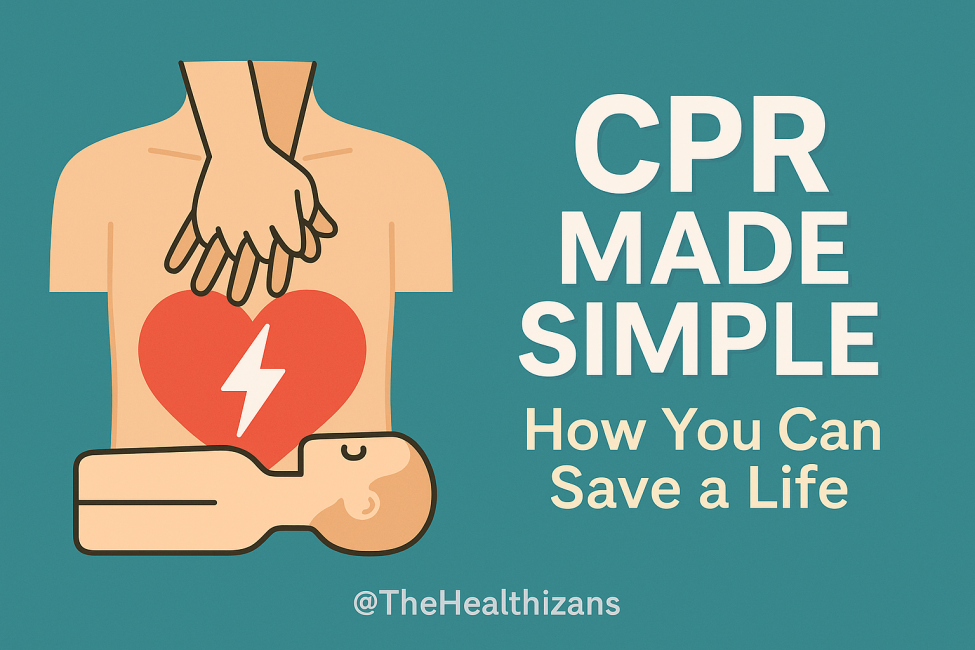
🙌 Hands-Only CPR: Step-by-Step
If you see someone suddenly collapse and they’re not breathing normally:
- Check for safety.
Make sure the scene is safe for you and the person. - Shout for help and call 999.
If possible, put your phone on loudspeaker so the operator can guide you through CPR. - Place your hands in the centre of the chest.
- Interlock your fingers.
- Keep your shoulders directly above your hands.
- Start chest compressions.
- Push hard and fast — 5–6 cm deep.
- Aim for 100–120 compressions per minute (roughly to the beat of Stayin’ Alive 🎵).
- Let the chest rise fully between pushes.
- Don’t stop until help arrives or the person starts breathing.
💬 If you’re not trained or feel unsure — don’t worry about rescue breaths. Hands-only CPR is enough to keep blood and oxygen moving.
⚡ Using an AED (Defibrillator)
If an AED is available — often found in schools, gyms, offices, and supermarkets — here’s what to do:
- Turn it on immediately. The device gives step-by-step voice instructions.
- Attach the pads to the chest as shown (upper right, lower left).
- Stand clear during analysis and shock delivery.
- Resume CPR as soon as the AED tells you.
💡 AEDs are designed for anyone to use — you can’t make a mistake.
🧠 Busting Common CPR Myths
Let’s clear up a few fears that stop people from helping:
- 🚫 “I’ll get sued if something goes wrong.”
👉 UK “Good Samaritan” protections mean you can’t be sued for trying to help in good faith. - 🚫 “I might break a rib.”
👉 It can happen — but it’s a small price to pay for saving a life. - 🚫 “I’ve forgotten how to do CPR.”
👉 Even if you only do hands-only compressions, you’re still keeping someone alive until help arrives. - 🚫 “AEDs are for professionals.”
👉 Not true — AEDs are built for anyone to use safely. Just switch it on and follow the voice prompts.
🫶 Why Everyone Should Learn CPR
In the UK, over 30,000 out-of-hospital cardiac arrests occur each year, but survival rates remain low because too few people act quickly.
Learning CPR means you can become that vital link in the Chain of Survival — the sequence that saves lives:
- Early recognition and calling for help
- Early CPR
- Early defibrillation
- Post-resuscitation care
Each link matters — and you might be the one to make it happen. If you haven’t already, checkout our article on how to recognise cardiac arrest.
💬 What’s Your Take?
Have you ever witnessed a cardiac arrest or seen a defibrillator in public? Would you feel confident using one now? Let’s talk 👇
📚 Sources
- British Heart Foundation (BHF). Learn CPR.
- Resuscitation Council UK. CPR and AED Guidelines 2021.
- NHS UK. How to Perform CPR.
About the Author