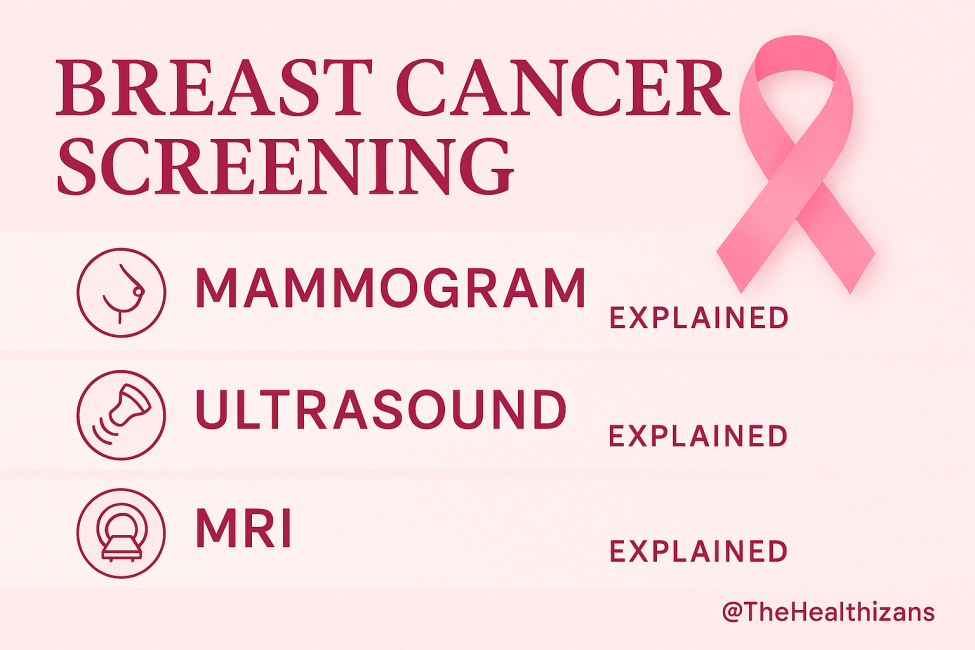
Regular breast cancer screening can detect changes long before symptoms appear — often years earlier. Early detection doesn’t just save lives; it can also mean less invasive treatment and better recovery outcomes. But with different screening methods available — mammogram, ultrasound, and MRI — many women wonder which one is right for them.
Let’s break them down in simple terms 👇
🩺 1. Mammogram: The Gold Standard of Screening
A mammogram is an X-ray of the breast that helps identify tumours too small to feel by hand. It’s considered the most effective tool for early breast cancer detection and forms the backbone of most national screening programmes, including the NHS Breast Screening Programme.
- ✅ Who it’s for: Women aged 50–71 are routinely invited for a free NHS mammogram every three years. Those at higher risk (for example, with strong family history) may start earlier.
- 🕒 What to expect: Each breast is gently compressed between two plates for a few seconds while the image is taken — it might feel uncomfortable, but not painful for most people.
- 🔍 Why it matters: Mammograms can detect cancers up to two years before a lump becomes palpable, dramatically improving outcomes.
🌊 2. Breast Ultrasound: A Closer Look for Younger or Dense Breasts
An ultrasound scan uses sound waves instead of X-rays to create images of the breast tissue. It’s particularly useful for younger women, whose breast tissue is denser, making mammograms harder to interpret.
- ✅ Who it’s for: Usually recommended for women under 40, for follow-up investigations, or if a lump is found during a physical exam.
- 🕒 What to expect: A gel is applied to the skin, and a handheld probe is moved over the breast. The process is painless and radiation-free.
- 🔍 Why it matters: Ultrasound can distinguish between solid tumours and fluid-filled cysts, helping doctors decide next steps.
🧠 3. Breast MRI: The High-Sensitivity Option
A breast MRI (magnetic resonance imaging) provides highly detailed images using magnetic fields and radio waves. It’s often used alongside mammography for women at very high genetic risk (for example, BRCA1 or BRCA2 mutation carriers).
- ✅ Who it’s for: Those with a strong family history, prior chest radiation, or unclear mammogram results.
- 🕒 What to expect: You’ll lie face-down in an MRI scanner for about 30–45 minutes. Contrast dye is often used to highlight any suspicious tissue.
- 🔍 Why it matters: MRI detects more cancers than mammography alone — though it can also pick up benign changes, so it’s not used as a routine test for everyone.
🧩 How Often Should You Get Screened?
Screening frequency depends on age, risk factors, and medical history.
- If you’re 50–71, attend your NHS screening every three years.
- If you have a family history, your GP may recommend earlier or annual screening.
- If you’ve had previous breast cancer, you’ll likely follow a specialist schedule for ongoing monitoring.
👉 Also, check out our post on Routine Screenings & Check-ups to learn about other essential health tests to stay ahead of disease.
💡 The Bottom Line
Each breast cancer screening method serves a unique purpose. Mammograms catch the earliest signs; ultrasounds clarify details; MRIs give deep insight for high-risk cases. Together, they form a powerful safety net — especially when paired with self-exams and prompt medical advice.
Remember: early detection is your strongest defence.
💬 What’s Your Take?
Have you ever had a breast screening? How was your experience — reassuring, uncomfortable, or empowering?
Share your story in the comments to help other women feel more confident about taking this step.
📚 Sources
- NHS. Breast cancer screening (mammogram)
- World Health Organization (WHO). Breast cancer: early diagnosis and screening.
- Cancer Research UK. Breast screening tests: Mammogram, Ultrasound and MRI.
About the Author