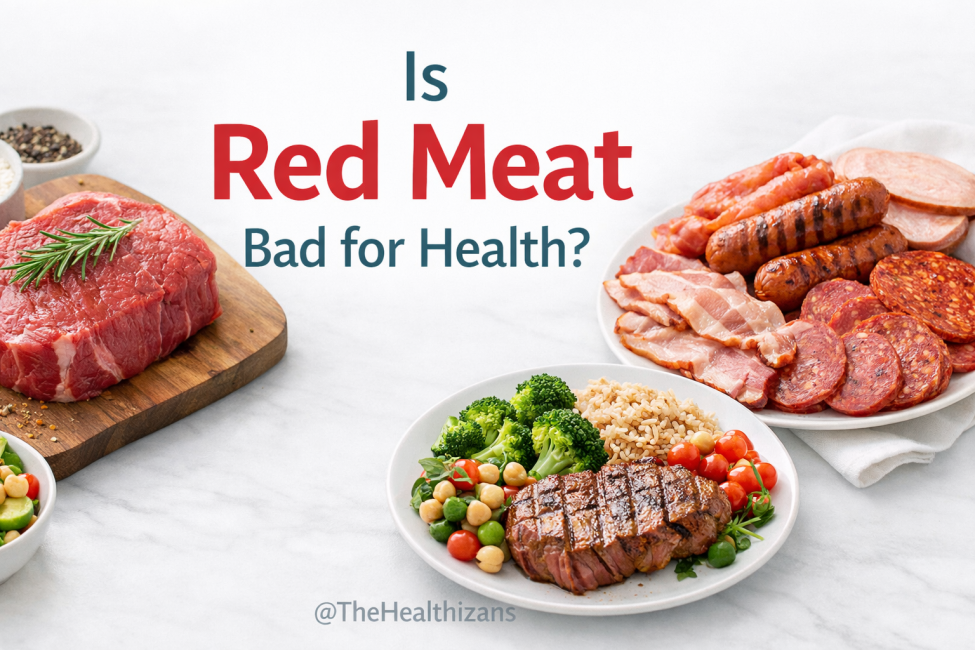
Is red meat bad for health? It’s one of the most debated questions in nutrition today.
From documentaries to social media debates, red meat is often portrayed as harmful — linked to heart disease, cancer, and shortened lifespan. On the other hand, many argue it is a nutrient-dense, traditional food that humans have consumed for centuries.
So what does the science actually say?
The truth is more nuanced than “good” or “bad.” Let’s unpack the evidence and look at where red meat fits in a balanced, evidence-based diet.
What Counts as Red Meat?
Red meat refers to meat from mammals. This includes:
- Beef
- Lamb
- Goat
- Pork
It is important to distinguish between unprocessed red meat and processed meat.
Unprocessed red meat includes fresh cuts such as steak, mince, or chops.
Processed meat includes bacon, sausages, ham, salami, hot dogs, and any meat preserved through smoking, curing, salting, or added preservatives.
This distinction matters significantly when discussing whether red meat is bad for health.
Red Meat and Heart Disease
Red meat is rich in:
- High-quality protein
- Iron (particularly haem iron, which is easily absorbed)
- Zinc
- Vitamin B12
However, some cuts are also high in saturated fat, which may raise LDL (“bad”) cholesterol when consumed in excess. Elevated LDL cholesterol is a known risk factor for cardiovascular disease.
The British Heart Foundation and the NHS advise limiting processed meat and choosing leaner cuts of red meat where possible [1][2].
Research suggests that processed meat carries a stronger association with heart disease compared with moderate intake of lean, unprocessed red meat. Overall dietary pattern — including fibre intake, fruit and vegetable consumption, and physical activity — plays a much larger role in heart health.
If you’re interested in protecting your cardiovascular system, you may also find our article on coronary artery disease helpful.
Red Meat and Cancer Risk
In 2015, the International Agency for Research on Cancer, part of the World Health Organization, evaluated the evidence on meat consumption and cancer risk [3].
Their findings:
- Processed meat was classified as carcinogenic to humans (Group 1).
- Red meat was classified as probably carcinogenic to humans (Group 2A).
This classification is primarily linked to colorectal cancer risk.
However, classification does not measure how large the risk is — only the strength of the evidence. The increased risk is associated with higher and more frequent consumption, particularly above recommended levels.
The NHS advises that if you regularly eat more than 90g of red and processed meat per day, you should reduce it to 70g or less [2].
Cooking methods may also matter. Very high-temperature cooking, such as charring or burning meat, can produce compounds that may increase cancer risk.
Is Red Meat Bad for Health — or Is It About Quantity?
The answer depends largely on:
- Portion size
- Frequency of intake
- Processing
- Cooking method
- Overall dietary pattern
Diets consistently associated with longevity — such as the Mediterranean diet — include small amounts of red meat but emphasise vegetables, legumes, whole grains, nuts, olive oil, and fish [4].
In other words, red meat is not usually the centrepiece of a healthy dietary pattern — but it is not necessarily excluded either.
As we often discuss in our balanced eating guidance, health is rarely about eliminating a single food. It’s about building a plate that supports long-term wellbeing.
Who Should Be More Cautious?
Certain individuals may benefit from limiting red meat further:
- People with high LDL cholesterol
- Those with a family history of colorectal cancer
- Individuals already consuming high amounts of processed meat
- People with established heart disease
If you are managing cholesterol levels, you may also want to read our article on cholesterol management for practical dietary strategies.
Practical Guidance: How to Eat Red Meat More Safely
If you choose to eat red meat, consider these evidence-informed steps:
- Choose lean cuts where possible
- Limit processed meats
- Keep portions moderate (around 70g cooked weight per day on average)
- Pair meat with fibre-rich vegetables and whole grains
- Avoid frequent heavy charring or burning
- Include plant-based protein sources throughout the week
Balance is key.
The Bottom Line
So, is red meat bad for health?
Processed meat: Strong evidence suggests limiting it.
Large, frequent portions of red meat: Associated with higher health risks.
Moderate amounts of lean, unprocessed red meat within a balanced diet: Can fit into a healthy lifestyle for most people.
No single food determines your health. Long-term dietary patterns matter far more than one ingredient on your plate.
The goal isn’t fear. It’s informed choice.
What’s Your Take?
Do you eat red meat regularly, occasionally, or not at all?
Have you reduced processed meat in your diet?
Share your thoughts in the comments — and let’s keep the conversation evidence-based and respectful.
Sources
- British Heart Foundation – Diet and heart health
- NHS – Red meat and the risk of bowel cancer
- International Agency for Research on Cancer (IARC), WHO – Carcinogenicity of consumption of red and processed meat
- Mediterranean diet research summaries
About the Author