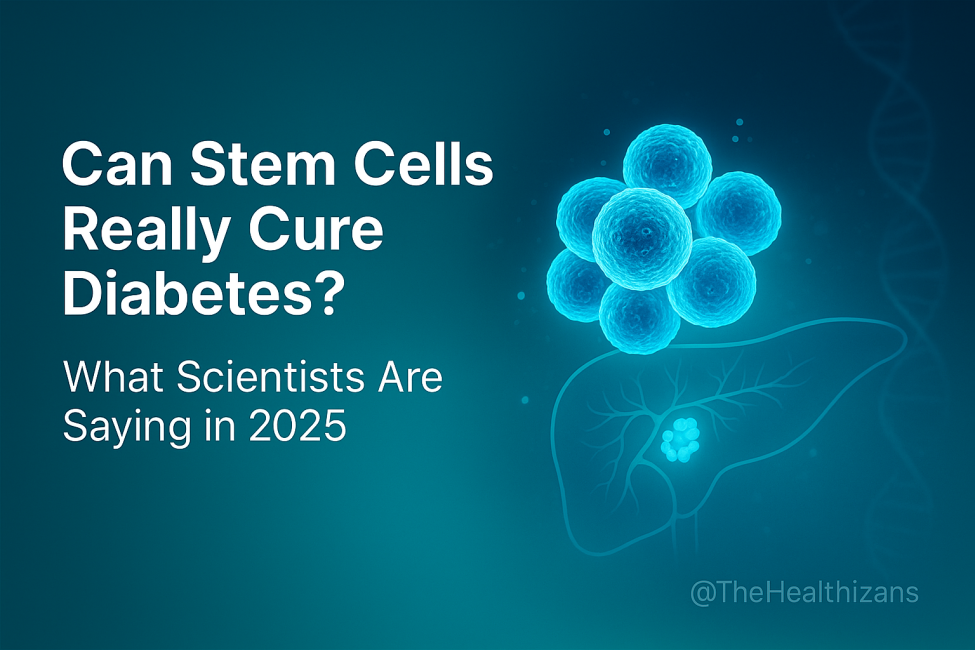
Every few months, social media explodes with headlines claiming a “cure for diabetes” — and in 2025, stem cell therapy is at the centre of the conversation. From China to the US, early clinical trials are showing something we’ve never seen before: some people with diabetes, especially type 1, are regaining the ability to produce insulin after receiving stem-cell-derived pancreatic cells.
It’s an exciting moment for science. But the big question remains: Can stem cells really cure diabetes? And if so — how close are we?
In this article, we break down the facts, the hope, and the hype to help you understand where the science truly stands.
(Also, check out our guide on How Diabetes Affects Your Eyes, Feet and Kidneys, as early organ changes are part of why the search for better treatments matters.)
What Are Stem Cells — and Why Are They So Important?
Stem cells are special because they can become almost any cell in the body. For diabetes, researchers are particularly interested in turning stem cells into beta cells — the insulin-producing cells in the pancreas that are destroyed in type 1 diabetes and weakened in advanced type 2.
If scientists can reliably create healthy replacement beta cells and protect them from immune attack, diabetes treatment could shift from lifelong management to something closer to regeneration.
What Has Actually Been Achieved So Far?
Here’s where the science gets interesting — and real:
✔ Documented cases of restored insulin production (Type 1)
Recent early-stage clinical trials have shown that some people with type 1 diabetes regained the ability to produce insulin after receiving stem-cell-derived islet cells. A well-publicised case from China involved a young woman who stopped taking insulin for over a year after treatment. Similar improvements have been reported in early trials by US and Canadian research teams.
These results suggest a functional reversal — at least temporarily.
✔ Lab-grown islet cells are now a real clinical product
Researchers can now grow pancreatic islet clusters from stem cells with high precision. These cells sense glucose and release insulin — just like natural beta cells.
✔ Better immunosuppression and encapsulation technologies
Some trials use protective capsules to shield transplanted cells from immune attack, reducing the need for strong immunosuppressive drugs.
What Scientists Still Don’t Know
Despite headline-worthy success, several major challenges remain:
❗ Immune attack
In type 1 diabetes, the immune system destroyed the original beta cells. That same immune system could attack the new transplanted cells unless carefully protected.
❗ Long-term durability
How long will the transplanted cells last?
Months? Years? A lifetime?
We don’t know yet.
❗ Safety
Stem cells can, in rare circumstances, lead to unwanted cell growth if not fully controlled.
❗ Type 2 diabetes is more complex
Even if beta cells are replaced, insulin resistance — the core issue in type 2 diabetes — may still remain. This makes a “quick cure” far less likely.
So… Can Stem Cells Cure Diabetes?
The most honest answer: Not yet — but the science is closer than ever.
What stem cells can do today:
- Restore insulin production in some type 1 patients
- Improve glucose control
- Reduce or eliminate insulin needs for short periods
- Provide a proof-of-concept for future regenerative therapies
What stem cells cannot do today:
- Cure diabetes in the mainstream sense
- Replace insulin for most patients
- Fully overcome immune rejection
- Provide a permanent solution for type 2 diabetes
The word “cure” is still too strong.
The word “breakthrough” is absolutely justified.
What’s Next in Stem Cell Research?
Scientists predict that this research will advance in three major directions:
1. Immune-protected stem-cell implants – Devices that hold beta cells and keep the immune system away.
2. Gene-edited stem cells – To resist autoimmune destruction altogether.
3. Personalised cell therapy – Using a patient’s own cells to avoid rejection.
These are not far-future ideas — they are in active development right now.
What’s Your Take?
Would you consider stem cell therapy if it became available?
Or do you feel cautious about the risks?
Share your thoughts — your perspective helps others understand this evolving science.
📚 Sources
- Medical News Today — Stem cell therapy reverses type 1 diabetes case study
- Stem Cell Research & Therapy Journal — iPSC-derived beta cell transplantation case report
- New England Journal of Medicine — Stem-cell derived islet transplantation trial data
- Diabetes UK — Stem cell & smart insulin research update
- The Lancet Diabetes & Endocrinology — Challenges in beta-cell replacement therapy
- Labiotech — Review of stem cell and regenerative therapies for diabetes
About the Author