🌟 Introduction: Why Form Matters Before Fitness
If you’ve just started exercising, here’s a truth worth remembering: technique beats intensity. Good form protects your joints, strengthens your muscles evenly, and helps you see results faster.
Think of it as learning to drive — you wouldn’t hit the motorway without knowing how to steer and brake! The same goes for movement. Once your form fundamentals is right, every squat, push-up, or plank becomes more effective and safer.
(If you’re following our First 14 Days of Fitness Plan, this is your next step toward feeling stronger and more confident.)
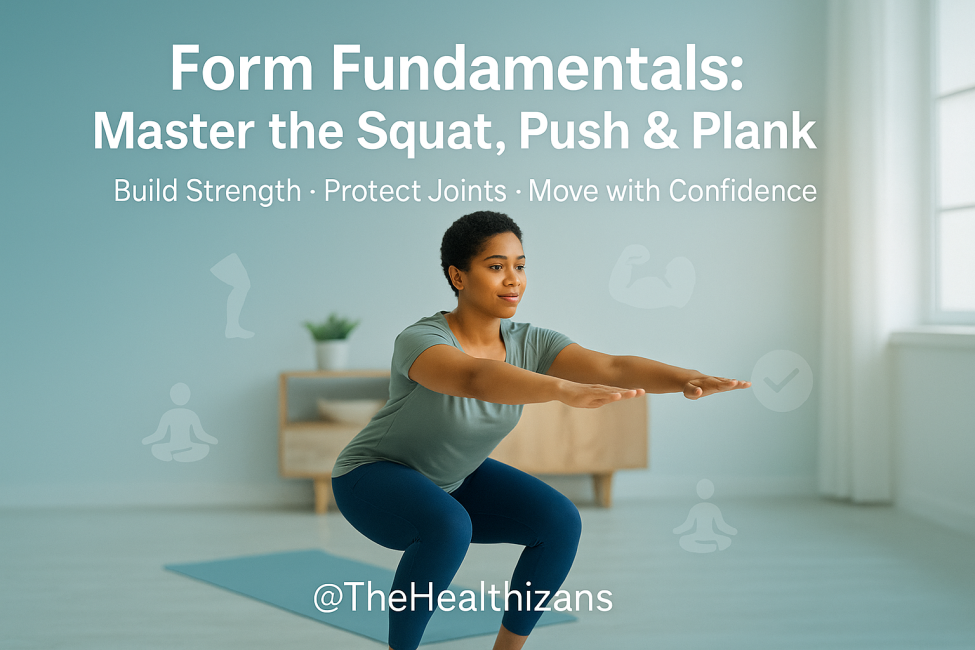
🏋️♀️ Step 1: The Squat — Strength Starts from the Ground Up
Squats work your legs, glutes, and core — but only when done with proper alignment.
✅ How to do it right:
- Stand with feet shoulder-width apart, toes slightly turned out.
- Keep your chest lifted, shoulders relaxed.
- As you lower down, push your hips back (like sitting on a chair).
- Keep knees tracking over your toes, not collapsing inward.
- Stop when thighs are parallel to the floor, then drive through your heels to stand.
💡 Quick fix: Can’t go low? Place a chair behind you and tap it lightly each rep. It builds confidence and balance.
⏱️ Beginner set: 10–12 reps × 2 rounds.
🤸 Step 2: The Push-Up — Upper Body Confidence
Push-ups build your chest, arms, and core, but many beginners start too advanced and strain their shoulders.
✅ How to do it right:
- Start on hands and knees, hands under shoulders, body in a straight line from head to knees.
- Lower your chest halfway down — not your hips.
- Keep elbows at a 45° angle from your body (not flared out).
- Push back up slowly and breathe out as you lift.
💡 Quick fix: Wall push-ups or incline push-ups (hands on a sturdy table or counter) are perfect starting points.
⏱️ Beginner set: 8–10 reps × 2 rounds.
🧘 Step 3: The Plank — Core Stability Over Crunches
Planks strengthen the core, back, and shoulders — improving posture and balance. It’s not about holding it forever; it’s about holding it right.
✅ How to do it right:
- Start on elbows and knees.
- Keep your back straight — no arching or sagging.
- Engage your abs as if zipping up your belly.
- Hold for 20–30 seconds, breathing steadily.
💡 Quick fix: Build gradually — start with 20 seconds, add 5 seconds each week.
⏱️ Beginner goal: 3 × 20-second holds.
🧠 Step 4: The Mind–Muscle Connection
When you move with intention, your results multiply. Focus on feeling the muscle you’re using — glutes during squats, chest during push-ups, core during planks.
Try to move slowly, with control, not speed. Remember: fast is flashy, but slow builds strength.
🔁 Step 5: Your 10-Minute Daily Form Routine
Here’s a simple daily structure:
| Move | Time / Reps | Focus |
| Warm-up (march in place, arm circles) | 2 mins | Increase blood flow |
| Squat to chair | 10–12 reps × 2 | Legs + posture |
| Incline push-up | 8–10 reps × 2 | Chest + shoulders |
| Plank (on knees) | 20s × 3 | Core + balance |
| Cool-down stretch | 2 mins | Release tension |
⏰ Total time: ~10 minutes — short enough to stay consistent, powerful enough to build real strength.
❤️ Step 6: Progress Safely
Once you can complete all reps with perfect form and no strain, you’re ready to:
- Add a third set of each move.
- Increase plank holds by 5–10 seconds.
- Swap chair squats for bodyweight squats.
- Move from knee to full push-ups.
Progress gradually — not perfectly. Listen to your body, and celebrate every gain.
💬 What’s Your Take?
Which move feels hardest — squats, push-ups, or planks? Tell us below 👇 and we’ll share a 60-second fix in our next reel!
📚 Sources
- NHS UK. Strength and flex exercises — official NHS guidance on proper form and safe strength-building routines.
- American Council on Exercise (ACE). Perfecting your squat and push-up form — expert tips on correct technique for beginners.
- Harvard Health Publishing. Core exercises: Build your middle for better balance and posture — detailed overview of the benefits of core training and planking.
- World Health Organization (WHO). Physical activity guidelines — global recommendations on strength and mobility for overall health.
About the Author