If you live with ADHD, staying focused can feel like trying to tune a radio that never quite lands on one station. Thoughts jump, emotions flare, and attention drifts — often at the worst possible moments. But what if training your attention on purpose could help calm the noise?
Recent research suggests that mindfulness for ADHD may do just that. Far from a spiritual buzzword, mindfulness has emerged as a clinically supported tool for improving focus, impulse control, and emotional regulation in both children and adults.
🧠 What Mindfulness Really Means
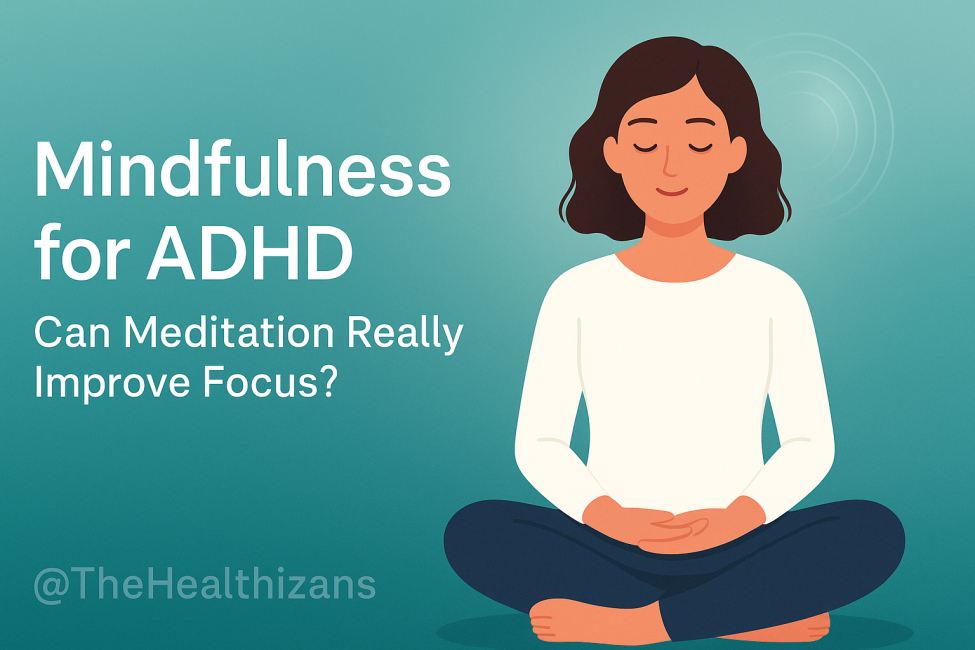
Mindfulness is the practice of paying full attention to the present moment — without judgement. It helps you notice distractions before they spiral and return your attention to what matters.
For individuals with ADHD, this skill is powerful. ADHD brains are naturally wired to wander, seek novelty, and react quickly. Mindfulness doesn’t fight that tendency; it helps manage it by strengthening the brain’s attention and awareness circuits.
🔬 What the Science Says
A growing body of research supports mindfulness-based interventions (MBIs) for ADHD:
- A 2023 study in Frontiers in Psychology found that mindfulness training improved attention span, emotional control, and working memory in adults with ADHD.
- Brain imaging studies show that meditation enhances activity in the prefrontal cortex — the part responsible for planning and impulse control.
- Even short daily sessions (10–15 minutes) can reduce restlessness and stress hormones.
The National Institute for Health and Care Excellence (NICE) also recognises behavioural therapies, including mindfulness and cognitive training, as useful complements to medication and parent-led interventions【Source 3 below】.
🪷 How Mindfulness Helps ADHD Minds
Mindfulness doesn’t “fix” ADHD — it builds awareness and self-regulation. Over time, this can lead to:
- Fewer emotional outbursts
- Better focus during work or study
- Improved task-switching
- Reduced anxiety and frustration
And because mindfulness activates the parasympathetic nervous system, it physically calms the body — slowing breathing and heart rate, which can reduce impulsive responses.
💡 Simple Mindfulness Exercises for Daily Life
You don’t need to sit cross-legged for hours to practise mindfulness. Start small:
- The 5-4-3-2-1 Technique — Name 5 things you see, 4 you feel, 3 you hear, 2 you smell, and 1 you taste. This grounds attention in the moment.
- Mindful Breathing (2 minutes) — Inhale deeply through your nose for 4 seconds, hold for 2, and exhale slowly for 6. Repeat and notice the rhythm.
- Body Scan — Pay attention to each part of your body from head to toe, observing sensations without judgement.
- Mindful Transitions — Before switching tasks, pause, take a deep breath, and consciously move to the next activity.
If your mind wanders — that’s normal. Each return to focus is like a push-up for your attention muscle.
📱 Using Technology Mindfully
Ironically, apps can help build mindfulness habits. Try tools such as Headspace, Calm, or Insight Timer, which offer ADHD-friendly guided sessions.
You can also pair mindfulness practice with screen management strategies from our recent article, Screen Time and ADHD: Is Your Phone Making It Worse?.
💬 For Parents of Children with ADHD
Mindfulness can also be taught to kids through playful activities — mindful colouring, deep breathing with bubbles, or short “listening games”. Research shows that children who learn mindfulness experience better classroom behaviour and emotional balance.
🌈 Final Thoughts
Mindfulness for ADHD isn’t about emptying the mind — it’s about noticing, pausing, and choosing your next response with awareness. Over time, these small daily pauses can create big shifts in focus, calm, and confidence.
💬 What’s Your Take?
Have you or your child tried mindfulness for ADHD? Did you notice any improvements in focus or calmness? Share your journey with us @TheHealthizans
📚 Sources
- Zylowska, L. et al. (2023). Mindfulness Meditation Training in Adults and Adolescents with ADHD: A Feasibility Study. Frontiers in Psychology.
- American Psychiatric Association (APA). (2023). Mindfulness-Based Interventions for ADHD.
- National Institute for Health and Care Excellence (NICE). (2018, updated 2023). Attention Deficit Hyperactivity Disorder: Diagnosis and Management (NG87).
- CHADD (Children and Adults with ADHD). (2024). Mindfulness and ADHD: The Research and the Practice.
- Harvard Health Publishing. (2024). How Meditation Changes the Brain.
About the Author