Chances are, you’ve eaten more than you intended — not because you were hungry, but because your plate was too big, the serving looked “normal,” or the restaurant portion was enormous.
Welcome to the world of portion distortion — a sneaky contributor to weight gain, blood sugar spikes, and sluggish energy. And the worst part? Most of us don’t even realise it’s happening.
Let’s dive into how this distortion crept into our lives and how you can reclaim control — no calorie counting or food scales needed.
🍔 What Is Portion Distortion?
Portion distortion refers to the growing mismatch between:
- What is served to us, and
- What is actually a healthy, recommended portion.
Over the past few decades, our “normal” has quietly expanded. A bagel that used to be the size of a hockey puck is now the size of a small plate. Sodas that were once 250ml are now 600ml+. And restaurant pasta bowls? Often three times what your body needs in one sitting.
This shift makes it hard to judge how much is too much — even when we’re eating “healthy” food.
📈 How Did Portion Sizes Get So Out of Control?
Here’s what research and history tell us:
- Marketing & value culture: “More food for your money” sounds good, but often means more salt, sugar, and excess calories.
- Plate sizes grew: The average dinner plate has increased by nearly 30% in diameter over the past 50 years.
- Super-sizing trends: Fast-food chains normalised large portions and trained our eyes to see them as standard.
- Social norms shifted: We often eat what’s in front of us, not what we need — and bigger portions have become the default.
👀 Visual Tricks That Lead You to Overeat
It’s not just the food — it’s the way it’s presented. Here are common traps:
| Visual Cue | What It Does | Example |
|---|---|---|
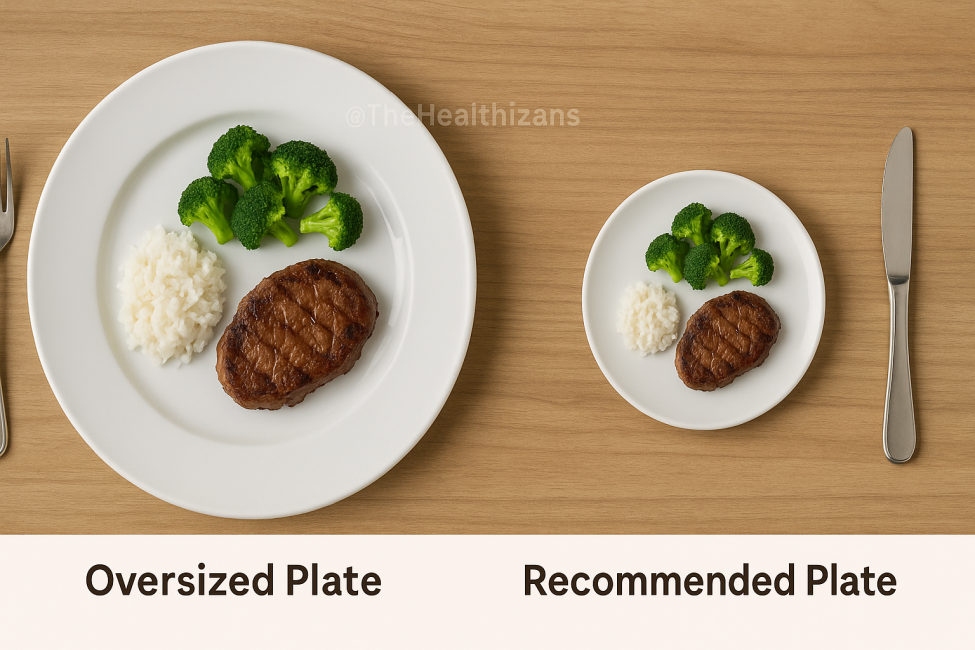
| 🌀 Bigger Plates | Makes portions look smaller | A cup of rice looks tiny on a large plate, so we add more |
| 🥤 Tall vs. Wide Glasses | Tricks the brain into thinking you drank less | People pour more into wide glasses but think they drank less |
| 📦 Family-sized Packaging | Encourages larger servings | More chips in the bag = more chips on your plate |
🧠 Tip: Use smaller plates and bowls at home. Research shows people naturally eat 20–25% less without even noticing.
🍱 What’s the Right Portion Anyway?
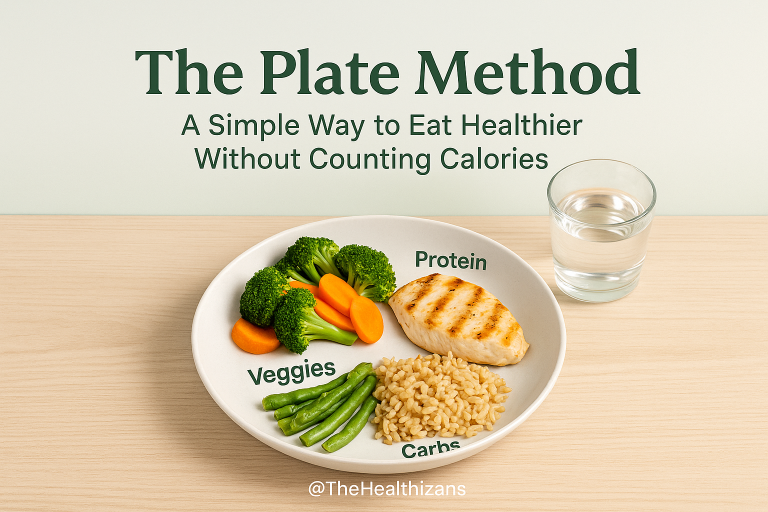
You don’t need to weigh or measure everything. Your hands can be your best built-in portion guide:
| Food Type | Hand Guide |
|---|---|
| 🍗 Protein (meat, beans, tofu) | Palm of your hand |
| 🥦 Vegetables | 2 cupped hands |
| 🍚 Whole grains/starch | 1 cupped hand |
| 🧈 Healthy fats | 1 thumb |
| 🍓 Snacks or treats | 1 cupped hand (or less!) |
✋ Hands come in all sizes — which is perfect! Your hand is proportional to your body size and needs.
🧠 Mindful Eating: The Anti-Distortion Superpower
To resist portion traps, try this:
- 🧘♀️ Pause before you eat: Ask “Am I hungry or just tempted?”
- 🍽️ Serve yourself, then step away: Avoid picking directly from large containers.
- ⏳ Eat slowly: Your brain needs ~20 minutes to register fullness.
- 🧾 Use the 80% rule: Stop eating when you’re about 80% full, not stuffed.
🌍 A Global Glimpse: How Cultures Keep Portions in Check
Balanced meals exist worldwide — and many cultures still get it right:
- 🇯🇵 Japanese bento: Small boxes with tiny compartments keep variety high and portions naturally limited.
- 🇫🇷 French meals: Smaller portions but eaten slowly and socially — leading to greater satisfaction.
- 🇳🇬 Traditional Nigerian dishes: Served with veggies, lean proteins, and smaller swallow portions — before fast food influence grew.
Modern life may have changed what we eat, but going back to basics can restore the balance.
✅ Quick Recap: Portion Fixes You Can Start Today
🔹 Swap large plates for 8–9” ones
🔹 Use your hand as a guide
🔹 Eat slower, without distractions
🔹 Don’t let packaging decide your portion
🔹 Serve mindfully, not mindlessly
💬 What’s Your Take?
Have you noticed portion distortion in your meals?
What strategies help you eat just enough — not too much?
Let’s share ideas below or on any of our social media platforms @TheHealthizans 💬
📚 Sources
- Rolls, B. J., et al. (2002). “Portion size of food affects energy intake in normal-weight and overweight men and women.” The American Journal of Clinical Nutrition, 76(6), 1207-1213.
- Wansink, B. (2004). “Environmental cues that influence food intake.” Nutrition Reviews, 62(7), 124–134.
- NIH: National Institute of Diabetes and Digestive and Kidney Diseases. www.niddk.nih.gov
- World Health Organization – Nutrition and Healthy Diet. www.who.int
About the Author